Will AI replace chefs and head cooks?

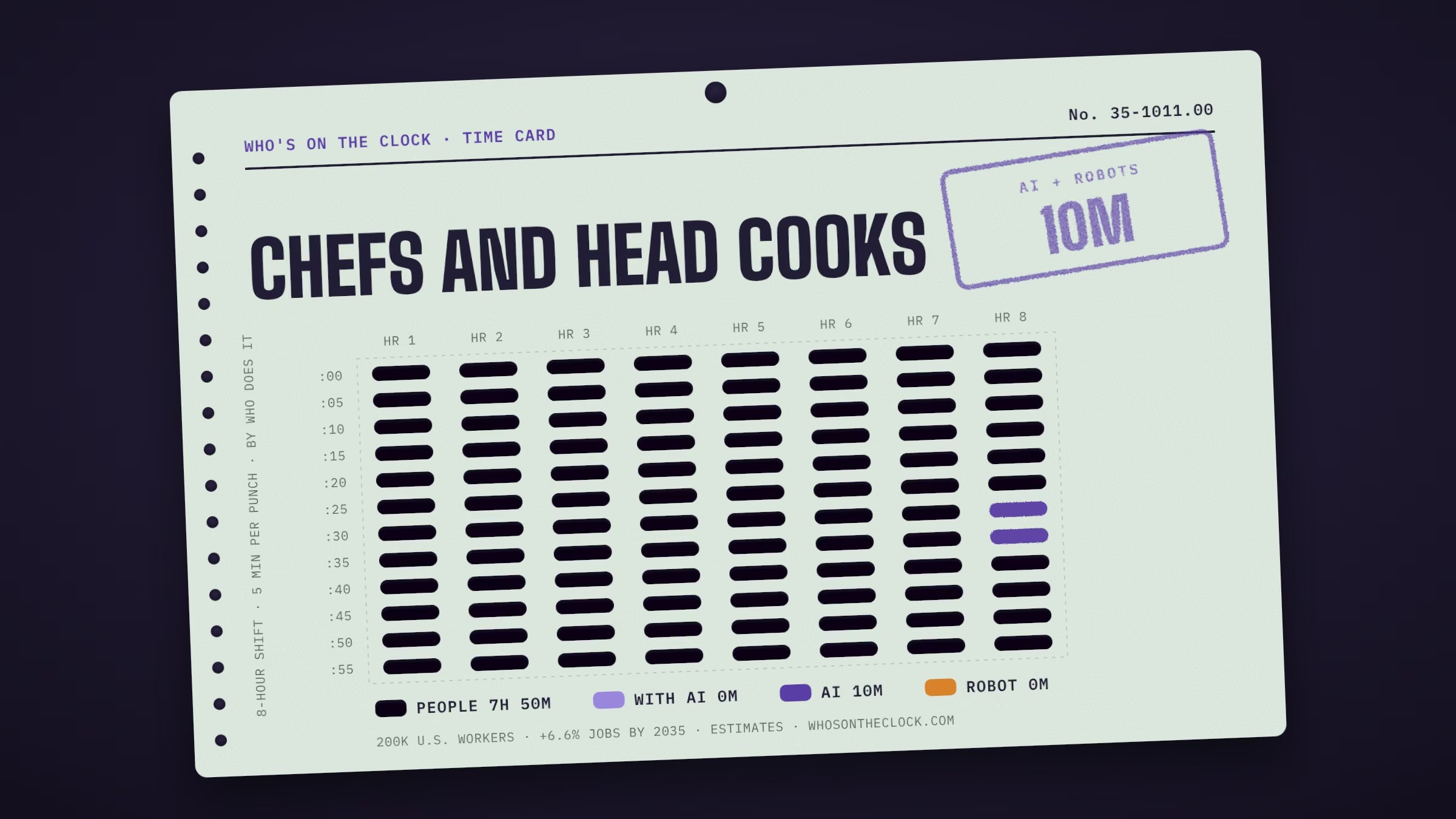
AI already handles some of this work on its own in real use, for tasks like “Record production or operational data on specified forms”. That's 10m of a typical shift; 7h 50m still has no AI or robot evidence. BLS expects about 6.6% more of these jobs by 2035.

Time card for chefs and head cooks showing a typical 8-hour shift: 7h 50m done by people, 10m by AI.
Each mark is 5 minutes of a typical shift for chefs and head cooks, colored by who does that task today. Estimates from O*NET tasks and Anthropic Economic Index data. How it's made

Home / Food service / Chefs and Head Cooks

Direct and may participate in the preparation, seasoning, and cooking of salads, soups, fish, meats, vegetables, desserts, or other foods. May plan and price menu items, order supplies, and keep records and accounts.

Time card

Untick tasks you don't do, or set your own times.
MineTask, by time spentHumanWith AIAIRobot
Prepare and cook foods of all types, either on a regular basis or for special guests or functions.2h 14m a shift · No AI or robot evidence found
Why this label?This is physical work, and no robot has been shown doing it yet. How labels work
Supervise or coordinate activities of cooks or workers engaged in food preparation.1h 17m a shift · No AI or robot evidence found
Why this label?No AI use or robot deployment showed up for this task in our data. That isn't proof it's safe; it may just be rare in the data. How labels work
Check the quality of raw or cooked food products to ensure that standards are met.31m a shift · Robots only in factory cells
Why this label?Robots have done this only in factory setups built around the machine, so it stays Human for chefs and head cooks. How labels work
Instruct cooks or other workers in the preparation, cooking, garnishing, or presentation of food.26m a shift · No AI or robot evidence found
Why this label?No AI use or robot deployment showed up for this task in our data. That isn't proof it's safe; it may just be rare in the data. How labels work
Monitor sanitation practices to ensure that employees follow standards and regulations.21m a shift · No AI or robot evidence found
Why this label?No AI use or robot deployment showed up for this task in our data. That isn't proof it's safe; it may just be rare in the data. How labels work
Order or requisition food or other supplies needed to ensure efficient operation.21m a shift · No AI or robot evidence found
Why this label?No AI use or robot deployment showed up for this task in our data. That isn't proof it's safe; it may just be rare in the data. How labels work
Determine how food should be presented and create decorative food displays.21m a shift · No AI or robot evidence found
Why this label?This is physical work, and no robot has been shown doing it yet. How labels work
Determine production schedules and staff requirements necessary to ensure timely delivery of services.21m a shift · No AI or robot evidence found
Why this label?No AI use or robot deployment showed up for this task in our data. That isn't proof it's safe; it may just be rare in the data. How labels work
Inspect supplies, equipment, or work areas to ensure conformance to established standards.16m a shift · No AI or robot evidence found
Why this label?This is physical work, and no robot has been shown doing it yet. How labels work
Check the quantity and quality of received products.16m a shift · Robots only in factory cells
Why this label?Robots have done this only in factory setups built around the machine, so it stays Human for chefs and head cooks. How labels work
Collaborate with other personnel to plan and develop recipes or menus, taking into account such factors as seasonal availability of ingredients or the likely number of customers.16m a shift · No AI or robot evidence found
Why this label?No AI use or robot deployment showed up for this task in our data. That isn't proof it's safe; it may just be rare in the data. How labels work
Estimate amounts and costs of required supplies, such as food and ingredients.10m a shift · No AI or robot evidence found
Why this label?No AI use or robot deployment showed up for this task in our data. That isn't proof it's safe; it may just be rare in the data. How labels work
Coordinate planning, budgeting, or purchasing for all the food operations within establishments such as clubs, hotels, or restaurant chains.10m a shift · No AI or robot evidence found
Why this label?No AI use or robot deployment showed up for this task in our data. That isn't proof it's safe; it may just be rare in the data. How labels work
Analyze recipes to assign prices to menu items, based on food, labor, and overhead costs.10m a shift · No AI or robot evidence found
Why this label?No AI use or robot deployment showed up for this task in our data. That isn't proof it's safe; it may just be rare in the data. How labels work
Plan, direct, or supervise food preparation or cooking activities of multiple kitchens or restaurants in an establishment such as a restaurant chain, hospital, or hotel.10m a shift · No AI or robot evidence found
Why this label?No AI use or robot deployment showed up for this task in our data. That isn't proof it's safe; it may just be rare in the data. How labels work
Recruit and hire staff, such as cooks and other kitchen workers.10m a shift · No AI or robot evidence found
Why this label?No AI use or robot deployment showed up for this task in our data. That isn't proof it's safe; it may just be rare in the data. How labels work
Record production or operational data on specified forms.10m a shift · Observed in AI useTypical AI request: about 3h 3m alone, 20m with AI
Why this label?Marked AI because this task shows up regularly in real AI conversations (Anthropic Economic Index, 2025 usage), and in most of them AI does the task on its own rather than helping a person. Many workplaces may not use AI for it at all. How labels work
Meet with customers to discuss menus for special occasions, such as weddings, parties, or banquets.5m a shift · No AI or robot evidence found
Why this label?No AI use or robot deployment showed up for this task in our data. That isn't proof it's safe; it may just be rare in the data. How labels work
Meet with sales representatives to negotiate prices or order supplies.5m a shift · No AI or robot evidence found
Why this label?No AI use or robot deployment showed up for this task in our data. That isn't proof it's safe; it may just be rare in the data. How labels work
Arrange for equipment purchases or repairs.5m a shift · No AI or robot evidence found
Why this label?No AI use or robot deployment showed up for this task in our data. That isn't proof it's safe; it may just be rare in the data. How labels work
Demonstrate new cooking techniques or equipment to staff.5m a shift · No AI or robot evidence found
Why this label?This is physical work, and no robot has been shown doing it yet. How labels work

Clock history

  1. 10m touchedFirst published: O*NET 30.1, Anthropic Economic Index (2025 usage and September 2026 robot study), BLS May 2025

When new data changes this clock, the date, the new numbers and the reason are logged here. Company news alone never moves the clock.

On the floor

  1. Rolling outWoohoo
    Dubai restaurant Woohoo has an AI model create its dishes

    Woohoo in Dubai uses Chef Aiman, a large language model trained on recipes and flavour pairings, to create its dishes.

    South China Morning Post

Ask the clock

Will AI replace chefs and head cooks?

Not on current evidence. Less than 30 minutes of a typical shift goes to tasks that AI or robots are doing today. The other 7h 50m (98%) stays with people. Separately, BLS expects about 6.6% more of these jobs by 2035 (all jobs: +3.5%).

What can AI already do for chefs and head cooks?

AI shows up regularly in 1 of 21 tasks, about 10m of a typical shift. The biggest ones:

  • Record production or operational data on specified forms. (10m a shift, AI mostly does it alone)
Where do robots fit in?

Not in workplaces like this one, based on a 2026 review of robot deployments. 2 more tasks have only been done in factory setups built around the machine, so they stay with people here. For 4 physical tasks, no robot has shown it can do the work yet.

What still needs a person?

7h 50m of a typical shift, or 98%, goes to tasks with no AI or robot evidence yet. No AI usage or robot deployment has shown up for these so far. The biggest:

  • Prepare and cook foods of all types, either on a regular basis or for special guests or functions. (2h 14m a shift)
  • Supervise or coordinate activities of cooks or workers engaged in food preparation. (1h 17m a shift)
  • Check the quality of raw or cooked food products to ensure that standards are met. (31m a shift)
  • Instruct cooks or other workers in the preparation, cooking, garnishing, or presentation of food. (26m a shift)
  • Monitor sanitation practices to ensure that employees follow standards and regulations. (21m a shift)
Why is that work hard to automate?

Much of it comes down to where and how the work happens. In-person, hands-on and high-stakes work is where AI and robots have made the least headway so far. In the official O*NET survey of people in this job:

  • 96% spend more than half the day on their feet
  • 92% work at arm's length or closer to other people
  • 92% use their hands on tools, objects or controls more than half the time
What are companies actually doing?

We track 1 sourced company move that affects this job. Most recent:

  • Nov 26, 2025: Dubai restaurant Woohoo has an AI model create its dishes (Rolling out)
How much time does AI save on these tasks?

For the 1 task in this job where AI shows up and timing data exists, a typical request takes about 3h 3m for a person alone and about 20m with AI. These are Claude's own estimates from real conversations in April and May 2026 (Anthropic Economic Index). They describe single requests, not whole workdays, and time saved on a task doesn't mean jobs are cut. The biggest gaps:

  • Record production or operational data on specified forms (about 3h 3m alone, 20m with AI)
Are employers still hiring chefs and head cooks?

On Indeed, job postings in the Food Preparation & Service sector are at 96% of their February 2020 level (all U.S. postings: 104%), down 3.1% from a year earlier, as of Oct 9, 2026. BLS separately expects about 25,000 openings a year in this job through 2035. Across all U.S. postings, 7.3% now mention AI skills. Sector postings cover more than this one job and move for many reasons besides AI.

How much do chefs and head cooks make?

The median pay is about $62,470 a year ($30.03 an hour), 23% above the median for all U.S. jobs ($50,980). Most people in this job earn between $37,900 and $98,560 a year; that range covers the middle 80%. Pay figures are from BLS, May 2025, and vary a lot by state and employer. Pick a state to compare:

Is this job growing or shrinking?

BLS projects growth of 6.6% from 2025 to 2035, compared with 3.5% growth for all jobs. That's about 235,000 jobs in 2035. It expects about 25,000 openings a year, mostly from people retiring or changing careers. These projections don't single out AI as a cause.

How many chefs and head cooks are there in the U.S.?

About 200,000 people in the U.S., roughly 0.13% of all workers (BLS, May 2025). That makes it the 171st largest of the 796 jobs on this site. BLS expects about 235,000 in 2035.

What training do chefs and head cooks need?

The most common requirement is an associate's degree: about 54% of people in the job said so in the official O*NET survey. O*NET rates the job at level 3 of 5 for preparation, which usually means: vocational school or associate's degree. Requirements vary by state and employer, especially for licensed work.

What should I learn to stay ahead of AI?

These come from the job's official skill ratings and from the tasks that AI and robots touch least today. Building them keeps you strong in the parts of the work that still need a person:

  • Skills that matter more here than in most jobs: Management of Material Resources, Coordination, Management of Personnel Resources, Management of Financial Resources
  • Get strong at the parts of the job that stay with people (listed above), which take 7h 50m of a typical shift
  • Tools employers list: Microsoft Word, Microsoft Outlook, Microsoft Office software, Microsoft Excel, Facebook
  • Learn to use AI well on the tasks where it already shows up in this job (listed above)
What other jobs could chefs and head cooks move into?

These use similar skills. Matches come from 109 official ratings of skills, knowledge and work activities, and each needs the same or less preparation unless the official list relates the jobs directly:

  • Food Service Managers (55m touched, $69k median pay)
  • First-Line Supervisors of Food Preparation and Serving Workers (1h 13m touched, $44k median pay)
How solid are these numbers?

Each task carries its own evidence label. For this job: 1 observed in real AI use, 20 with no AI or robot evidence found. The minutes per task are estimates, not measured hours, and "no evidence" doesn't prove a task is safe.

Tools in demand

  • Facebook
  • Google Sheets

Plus everyday office tools: Microsoft Word, Microsoft Outlook, Microsoft Office software, Microsoft Excel, Microsoft PowerPoint.

Also called

Baker, Banquet Chef, Bread and Pastry Baker, Cake Froster, Cake Icer, Cake Maker, Cake Mixer, Certified Executive Chef (CEC), Chef, Chef Manager, Chef de Cuisine, Chef de Froid, Chocolatier, Confectioner