Will AI replace drilling and boring machine tool setters, operators, and tenders, metal and plastic?
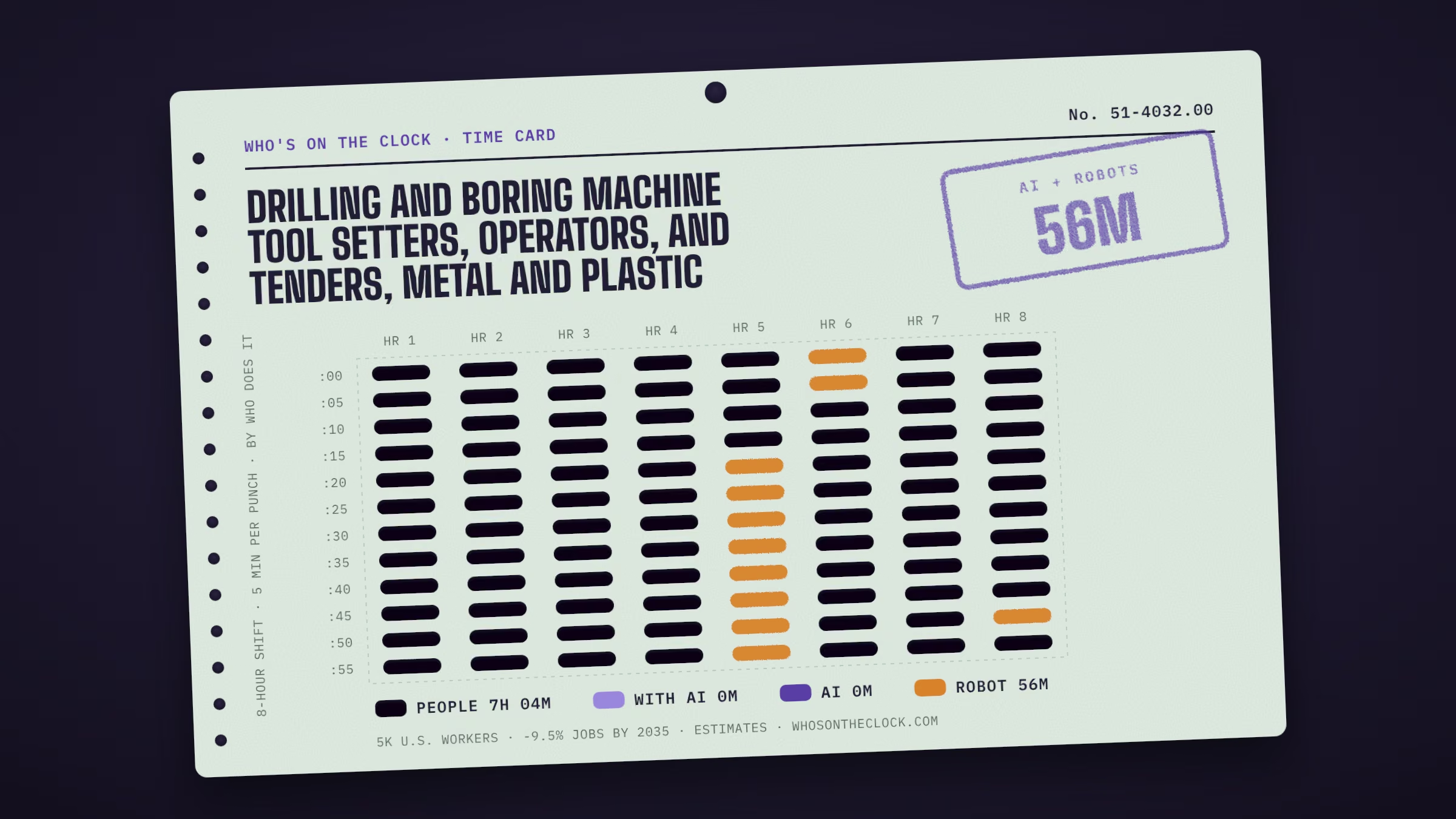
Unlikely, though parts of the work are changing. About 56m of an 8-hour shift goes to tasks touched by robots. The other 7h 4m (88%) stays with people. Separately, BLS expects about 9.5% fewer of these jobs by 2035 (all jobs: +3.5%).
⤢ Full sizeEach mark is 5 minutes of a typical shift for drilling and boring machine tool setters, operators, and tenders, metal and plastic, colored by who does that task today. Estimates from O*NET tasks and Anthropic Economic Index data. How it's made
Home / Production & factory / Drilling and Boring Machine Tool Setters, Operators, and Tenders, Metal and Plastic
Set up, operate, or tend drilling machines to drill, bore, ream, mill, or countersink metal or plastic work pieces.
Time card
Untick tasks you don't do, or set your own times.
Mine
Task, by time spent
Human
With AI
AI
Robot
Operate single- or multiple-spindle drill presses to bore holes so that machining operations can be performed on metal or plastic workpieces.1h 40m a shift · Robots only in factory cells
Position and secure workpieces on tables, using bolts, jigs, clamps, shims, or other holding devices.56m a shift · Robots only in factory cells
Observe drilling or boring machine operations to detect any problems.56m a shift · No AI or robot evidence found
Verify conformance of machined work to specifications, using measuring instruments, such as calipers, micrometers, or fixed or telescoping gauges.50m a shift · Robots only in factory cells
Study machining instructions, job orders, or blueprints to determine dimensional or finish specifications, sequences of operations, setups, or tooling requirements.31m a shift · No AI or robot evidence found
Select and set cutting speeds, feed rates, depths of cuts, and cutting tools, according to machining instructions or knowledge of metal properties.25m a shift · Robots only in factory cells
Lift workpieces onto work tables either manually or with hoists or direct crane operators to lift and position workpieces.25m a shift · Robots only in factory cells
Install tools in spindles.19m a shift · Robots only in factory cells
Establish zero reference points on workpieces, such as at the intersections of two edges or over hole locations.12m a shift · Robots only in factory cells
Change worn cutting tools, using wrenches.12m a shift · Robots only in factory cells
Perform minor assembly, such as fastening parts with nuts, bolts, or screws, using power tools or hand tools.12m a shift · Robots only in factory cells
Lay out reference lines and machining locations on work, using layout tools, and applying knowledge of shop math and layout techniques.12m a shift · Robots only in factory cells
Verify that workpiece reference lines are parallel to the axis of table rotation, using dial indicators mounted in spindles.6m a shift · Robots only in factory cells
Sharpen cutting tools, using bench grinders.6m a shift · Robots only in factory cells
Operate tracing attachments to duplicate contours from templates or models.time not estimated · Robots only in factory cells
On the floor
No company news tracked for this job yet. New stories are added as they happen.
Ask the clock
Will AI replace drilling and boring machine tool setters, operators, and tenders, metal and plastic?
Unlikely, though parts of the work are changing. About 56m of an 8-hour shift goes to tasks touched by robots. The other 7h 4m (88%) stays with people. Separately, BLS expects about 9.5% fewer of these jobs by 2035 (all jobs: +3.5%).
What can AI already do for drilling and boring machine tool setters, operators, and tenders, metal and plastic?
None of this job's tasks show regular AI use yet. That can mean the work is hands-on or in person, or simply that it rarely comes up in AI usage data.
Where do robots fit in?
For some tasks, yes. Robots have done 2 of this job's tasks in workplaces like this one, about 56m of a typical shift. 13 more tasks have only been done in factory setups built around the machine, so they stay with people here.
Move machine controls to lower tools to workpieces and to engage automatic feeds. (50m a shift; e.g. Universal Robots UR10 cobot at STAMIT s.r.o., in use)
Turn valves and direct flow of coolants or cutting oil over cutting areas. (6m a shift; e.g. CNC M-code coolant valve control (M07/M08/M09), in use)
What still needs a person?
7h 4m of a typical shift, or 88%, goes to tasks with no AI or robot evidence yet. No AI usage or robot deployment has shown up for these so far. The biggest:
Operate single- or multiple-spindle drill presses to bore holes so that machining operations can be performed on metal or plastic workpieces. (1h 40m a shift)
Position and secure workpieces on tables, using bolts, jigs, clamps, shims, or other holding devices. (56m a shift)
Observe drilling or boring machine operations to detect any problems. (56m a shift)
Verify conformance of machined work to specifications, using measuring instruments, such as calipers, micrometers, or fixed or telescoping gauges. (50m a shift)
Study machining instructions, job orders, or blueprints to determine dimensional or finish specifications, sequences of operations, setups, or tooling requirements. (31m a shift)
Why is that work hard to automate?
Much of it comes down to where and how the work happens. In-person, hands-on and high-stakes work is where AI and robots have made the least headway so far. In the official O*NET survey of people in this job:
90% use their hands on tools, objects or controls more than half the time
75% spend more than half the day on their feet
64% carry high or very high responsibility for other workers' safety
Are employers still hiring drilling and boring machine tool setters, operators, and tenders, metal and plastic?
On Indeed, job postings in the Production & Manufacturing sector are at 124% of their February 2020 level (all U.S. postings: 104%), up 12.6% from a year earlier, as of Oct 9, 2026. BLS separately expects about 400 openings a year in this job through 2035. Across all U.S. postings, 7.3% now mention AI skills. Sector postings cover more than this one job and move for many reasons besides AI.
How much do drilling and boring machine tool setters, operators, and tenders, metal and plastic make?
The median pay is about $49,080 a year ($23.60 an hour), 4% below the median for all U.S. jobs ($50,980). Most people in this job earn between $36,300 and $68,410 a year; that range covers the middle 80%. Pay figures are from BLS, May 2025, and vary a lot by state and employer. Pick a state to compare:
Is this job growing or shrinking?
BLS projects a decline of 9.5% from 2025 to 2035, compared with 3.5% growth for all jobs. That's about 4,200 jobs in 2035. Even so, it expects about 400 openings a year, mostly from people retiring or changing careers. These projections don't single out AI as a cause.
How many drilling and boring machine tool setters, operators, and tenders, metal and plastic are there in the U.S.?
About 4,680 people in the U.S., roughly 0.00% of all workers (BLS, May 2025). That makes it the 732nd largest of the 796 jobs on this site. BLS expects about 4,200 in 2035.
What training do drilling and boring machine tool setters, operators, and tenders, metal and plastic need?
The most common requirement is a high school diploma: about 57% of people in the job said so in the official O*NET survey. O*NET rates the job at level 2 of 5 for preparation, which usually means: high school diploma, some training. Requirements vary by state and employer, especially for licensed work.
What should I learn to stay ahead of AI?
These come from the job's official skill ratings and from the tasks that AI and robots touch least today. Building them keeps you strong in the parts of the work that still need a person:
Skills that matter more here than in most jobs: Operations Monitoring, Operation and Control, Time Management, Complex Problem Solving
Get strong at the parts of the job that stay with people (listed above), which take 7h 4m of a typical shift
Tools employers list: Microsoft Excel, Microsoft Office software, Microsoft Word, SAP software
What other jobs could drilling and boring machine tool setters, operators, and tenders, metal and plastic move into?
These use similar skills, with less of a typical shift touched by AI or robots. Matches come from 109 official ratings of skills, knowledge and work activities, and each needs the same or less preparation unless the official list relates the jobs directly:
Forging Machine Setters, Operators, and Tenders, Metal and Plastic (17m touched, $49k median pay)
Engine and Other Machine Assemblers (0m touched, $54k median pay)
Glass Blowers, Molders, Benders, and Finishers (0m touched, $46k median pay)
Woodworking Machine Setters, Operators, and Tenders (12m touched, $43k median pay)
Electromechanical Equipment Assemblers (0m touched, $46k median pay)
How solid are these numbers?
Each task carries its own evidence label. For this job: 2 with robots in real deployments, 15 with no AI or robot evidence found. The minutes per task are estimates, not measured hours, and "no evidence" doesn't prove a task is safe.