Will AI replace library technicians?

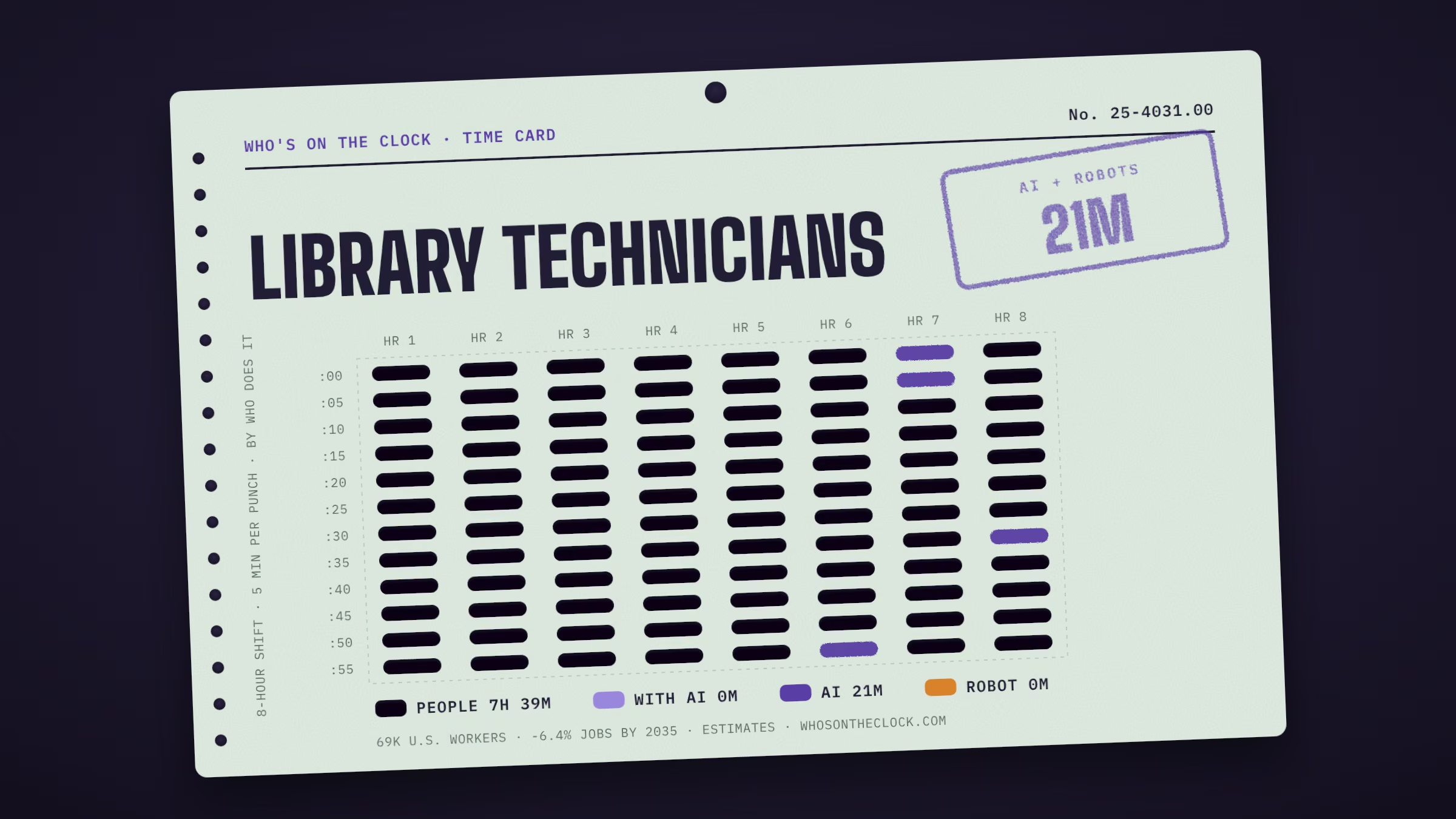
Not on current evidence. Less than 30 minutes of a typical shift goes to tasks that AI or robots are doing today. The other 7h 38m (96%) stays with people. Separately, BLS expects about 6.4% fewer of these jobs by 2035 (all jobs: +3.5%).

Time card for library technicians showing a typical 8-hour shift: 7h 38m done by people, 21m by AI.
Each mark is 5 minutes of a typical shift for library technicians, colored by who does that task today. Estimates from O*NET tasks and Anthropic Economic Index data. How it's made

Home / Education / Library Technicians

Assist librarians by helping readers in the use of library catalogs, databases, and indexes to locate books and other materials; and by answering questions that require only brief consultation of standard reference. Compile records; sort and shelve books or other media; remove or repair damaged books or other media; register patrons; and check materials in and out of the circulation process. Replace materials in shelving area (stacks) or files. Includes bookmobile drivers who assist with providing services in mobile libraries.

Time card

Untick tasks you don't do, or set your own times.
MineTask, by time spentHumanWith AIAIRobot
Reserve, circulate, renew, and discharge books and other materials.1h 18m a shift · Robots only in factory cells
Help patrons find and use library resources, such as reference materials, audio-visual equipment, computers, and other electronic resources and provide technical assistance when needed.49m a shift · No AI or robot evidence found
Catalogue and sort books and other print and non-print materials according to procedure and return them to shelves, files, or other designated storage areas.49m a shift · Robots only in factory cells
Answer routine telephone or in-person reference inquiries, referring patrons to librarians for further assistance, when necessary.35m a shift · No AI or robot evidence found
Process print and non-print library materials to prepare them for inclusion in library collections.28m a shift · Robots only in factory cells
Deliver and retrieve items throughout the library by hand or using pushcart.21m a shift · Robots only in factory cells
Enter and update patrons' records on computers.14m a shift · No AI or robot evidence found
Provide assistance to teachers and students by locating materials and helping to complete special projects.14m a shift · No AI or robot evidence found
Compile and maintain records relating to circulation, materials, and equipment.14m a shift · No AI or robot evidence found
Maintain and troubleshoot problems with library equipment, including computers, photocopiers, and audio-visual equipment.14m a shift · No AI or robot evidence found
Check for damaged library materials, such as books or audio-visual equipment, and provide replacements or make repairs.14m a shift · Robots only in factory cells
Train other staff, volunteers, or student assistants and schedule and supervise their work.14m a shift · No AI or robot evidence found
Conduct reference searches, using printed materials and in-house and online databases.14m a shift · Observed in AI useTypical AI request: about 4h 49m alone, 29m with AI
Process interlibrary loans for patrons.14m a shift · Robots only in factory cells
Plan and conduct children's programs, community outreach programs, and other specialized programs, such as library tours.14m a shift · No AI or robot evidence found
Take actions to halt disruption of library activities by problem patrons.7m a shift · No AI or robot evidence found
Collect fines and respond to complaints about fines.7m a shift · No AI or robot evidence found
Compile data and create statistical reports on library usage.7m a shift · No AI or robot evidence found
Design posters and special displays to promote use of library facilities or specific reading programs at libraries.7m a shift · No AI or robot evidence found
Issue identification cards to borrowers.7m a shift · No AI or robot evidence found
Review subject matter of materials to be classified and select classification numbers and headings according to classification systems.7m a shift · No AI or robot evidence found
Order all print and non-print library materials, checking prices, figuring costs, preparing order slips, and making payments.7m a shift · No AI or robot evidence found
Send out notices about lost or overdue books.7m a shift · No AI or robot evidence found
Retrieve information from central databases for storage in a library's computer.7m a shift · Observed in AI use
Verify bibliographical data for materials, including author, title, publisher, publication date, and edition.7m a shift · No AI or robot evidence found
Organize and maintain periodicals and reference materials.7m a shift · Robots only in factory cells
Sort and deliver library mail and packages.7m a shift · Robots only in factory cells
Operate and maintain audio-visual equipment, such as projectors, tape recorders, and videocassette recorders.7m a shift · Robots only in factory cells
Claim missing issues of periodicals and journals.time not estimated · No AI or robot evidence found
Compose explanatory summaries of contents of books and other reference materials.time not estimated · Observed in AI useTypical AI request: about 4h 58m alone, 28m with AI
Compile bibliographies and prepare abstracts on subjects of interest to particular organizations or groups.time not estimated · Observed in AI use

On the floor

No company news tracked for this job yet. New stories are added as they happen.

Ask the clock

Will AI replace library technicians?

Not on current evidence. Less than 30 minutes of a typical shift goes to tasks that AI or robots are doing today. The other 7h 38m (96%) stays with people. Separately, BLS expects about 6.4% fewer of these jobs by 2035 (all jobs: +3.5%).

What can AI already do for library technicians?

AI shows up regularly in 2 of 31 tasks, about 21m of a typical shift. The biggest ones:

  • Conduct reference searches, using printed materials and in-house and online databases. (14m a shift, AI mostly does it alone)
  • Retrieve information from central databases for storage in a library's computer. (7m a shift, AI mostly does it alone)
Where do robots fit in?

Not in workplaces like this one, based on a 2026 review of robot deployments. 9 more tasks have only been done in factory setups built around the machine, so they stay with people here. For 2 physical tasks, no robot has shown it can do the work yet.

What still needs a person?

7h 38m of a typical shift, or 96%, goes to tasks with no AI or robot evidence yet. No AI usage or robot deployment has shown up for these so far. The biggest:

  • Reserve, circulate, renew, and discharge books and other materials. (1h 18m a shift)
  • Help patrons find and use library resources, such as reference materials, audio-visual equipment, computers, and other electronic resources and provide technical assistance when needed. (49m a shift)
  • Catalogue and sort books and other print and non-print materials according to procedure and return them to shelves, files, or other designated storage areas. (49m a shift)
  • Answer routine telephone or in-person reference inquiries, referring patrons to librarians for further assistance, when necessary. (35m a shift)
  • Process print and non-print library materials to prepare them for inclusion in library collections. (28m a shift)
Why is that work hard to automate?

Much of it comes down to where and how the work happens. In-person, hands-on and high-stakes work is where AI and robots have made the least headway so far. In the official O*NET survey of people in this job:

  • 80% talk face to face with others every day
  • 59% say dealing with the public is very or extremely important
  • 59% work at arm's length or closer to other people
How much time does AI save on these tasks?

For the 1 task in this job where AI shows up and timing data exists, a typical request takes about 4h 49m for a person alone and about 29m with AI. These are Claude's own estimates from real conversations in April and May 2026 (Anthropic Economic Index). They describe single requests, not whole workdays, and time saved on a task doesn't mean jobs are cut. The biggest gaps:

  • Conduct reference searches, using printed materials and in-house and online databases (about 4h 49m alone, 29m with AI)
Are employers still hiring library technicians?

On Indeed, job postings in the Education & Instruction sector are at 107% of their February 2020 level (all U.S. postings: 104%), down 9.5% from a year earlier, as of Oct 9, 2026. BLS separately expects about 11,000 openings a year in this job through 2035. Across all U.S. postings, 7.3% now mention AI skills. Sector postings cover more than this one job and move for many reasons besides AI.

How much do library technicians make?

The median pay is about $44,580 a year ($21.43 an hour), 13% below the median for all U.S. jobs ($50,980). Most people in this job earn between $29,300 and $63,080 a year; that range covers the middle 80%. Pay figures are from BLS, May 2025, and vary a lot by state and employer. Pick a state to compare:

Is this job growing or shrinking?

BLS projects a decline of 6.4% from 2025 to 2035, compared with 3.5% growth for all jobs. That's about 68,000 jobs in 2035. Even so, it expects about 11,000 openings a year, mostly from people retiring or changing careers. These projections don't single out AI as a cause.

How many library technicians are there in the U.S.?

About 69,000 people in the U.S., roughly 0.04% of all workers (BLS, May 2025). That makes it the 330th largest of the 796 jobs on this site. BLS expects about 68,000 in 2035.

What training do library technicians need?

The most common requirement is a bachelor's degree: about 30% of people in the job said so in the official O*NET survey. O*NET rates the job at level 3 of 5 for preparation, which usually means: vocational school or associate's degree. Requirements vary by state and employer, especially for licensed work.

What should I learn to stay ahead of AI?

These come from the job's official skill ratings and from the tasks that AI and robots touch least today. Building them keeps you strong in the parts of the work that still need a person:

  • Skills that matter more here than in most jobs: Learning Strategies, Service Orientation, Reading Comprehension, Coordination
  • Get strong at the parts of the job that stay with people (listed above), which take 7h 38m of a typical shift
  • Tools employers list: Microsoft Office software, Microsoft Excel, Adobe Acrobat, Adobe Illustrator, Adobe InDesign
  • Learn to use AI well on the tasks where it already shows up in this job (listed above)
What new tasks are library technicians taking on?

Yes. Occupational experts recently added these to the official task list, a sign of how the work itself is shifting. New tasks aren't rated for AI or robots yet:

  • Open and close the library.
What other jobs could library technicians move into?

These use similar skills. Matches come from 109 official ratings of skills, knowledge and work activities, and each needs the same or less preparation unless the official list relates the jobs directly:

  • Clerical Library Assistants (2h 25m touched, $37k median pay)
  • General Office Clerks (4h 30m touched, $45k median pay)
  • Stockers and Order Fillers (1h 17m touched, $37k median pay)
  • Secretaries and Administrative Assistants (3h 53m touched, $48k median pay)
How solid are these numbers?

Each task carries its own evidence label. For this job: 4 observed in real AI use, 27 with no AI or robot evidence found. The minutes per task are estimates, not measured hours, and "no evidence" doesn't prove a task is safe.

Tools in demand

  • Microsoft Office software
  • Microsoft Excel
  • Adobe Acrobat
  • Adobe Illustrator
  • Adobe InDesign
  • Adobe Photoshop
  • Microsoft Access
  • Microsoft Outlook

Also called

Accessioner, Audio-Visual Aide, Bibliographer, Bindery Library Technical Assistant, Book Shelver, Book Sorter, Bookmobile Driver, Cataloging Library Technical Assistant (Cataloging LTA), Circulation Clerk, Classifier, Elementary Library Media Specialist, Librarian Helper, Library Acquisitions Technician, Library Aide