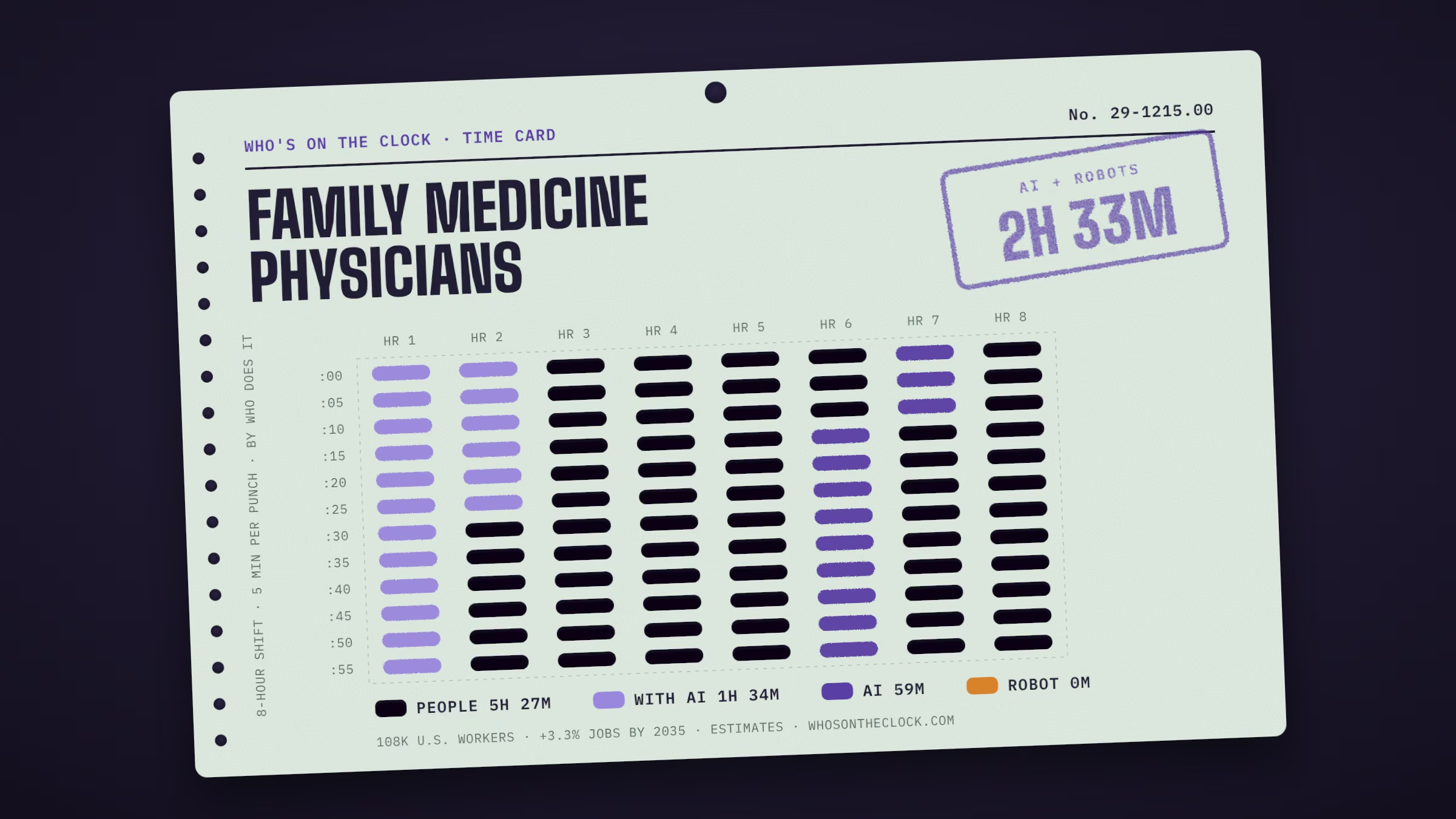
Unlikely, though parts of the work are changing. About 2h 34m of an 8-hour shift goes to tasks touched by AI that people use as a helper. The breakdown: 1h 34m done by people with AI help, 59m that AI mostly does alone. The other 5h 26m (68%) stays with people. Separately, BLS expects about 3.3% more of these jobs by 2035 (all jobs: +3.5%).
⤢ Full sizeEach mark is 5 minutes of a typical shift for family medicine physicians, colored by who does that task today. Estimates from O*NET tasks and Anthropic Economic Index data. How it's made
Diagnose, treat, and provide preventive care to individuals and families across the lifespan. May refer patients to specialists when needed for further diagnosis or treatment.
Time card
Untick tasks you don't do, or set your own times.
Mine
Task, by time spent
Human
With AI
AI
Robot
Collect, record, and maintain patient information, such as medical history, reports, or examination results.1h 34m a shift · Observed in AI use
Prescribe or administer treatment, therapy, medication, vaccination, and other specialized medical care to treat or prevent illness, disease, or injury.1h 24m a shift · No AI or robot evidence found
Order, perform, and interpret tests and analyze records, reports, and examination information to diagnose patients' condition.1h 19m a shift · No AI or robot evidence found
Monitor patients' conditions and progress and reevaluate treatments as necessary.59m a shift · No AI or robot evidence found
Explain procedures and discuss test results or prescribed treatments with patients.59m a shift · Observed in AI useTypical AI request: about 1h 30m alone, 30m with AI
Advise patients and community members concerning diet, activity, hygiene, and disease prevention.30m a shift · No AI or robot evidence found
Coordinate work with nurses, social workers, rehabilitation therapists, pharmacists, psychologists, and other health care providers.20m a shift · No AI or robot evidence found
Direct and coordinate activities of nurses, students, assistants, specialists, therapists, and other medical staff.15m a shift · No AI or robot evidence found
Refer patients to medical specialists or other practitioners when necessary.15m a shift · No AI or robot evidence found
Train residents, medical students, and other health care professionals.15m a shift · No AI or robot evidence found
Plan, implement, or administer health programs or standards in hospitals, businesses, or communities for prevention or treatment of injury or illness.5m a shift · No AI or robot evidence found
Prepare government or organizational reports which include birth, death, and disease statistics, workforce evaluations, or medical status of individuals.5m a shift · No AI or robot evidence found
Cleveland Clinic's AI scribe cut clinicians' daily note time by 14 minutes on average. At Cooper University Healthcare, Dragon Copilot saved about 4 minutes per patient.
Unlikely, though parts of the work are changing. About 2h 34m of an 8-hour shift goes to tasks touched by AI that people use as a helper. The breakdown: 1h 34m done by people with AI help, 59m that AI mostly does alone. The other 5h 26m (68%) stays with people. Separately, BLS expects about 3.3% more of these jobs by 2035 (all jobs: +3.5%).
What can AI already do for family medicine physicians?
AI shows up regularly in 2 of 12 tasks, about 2h 34m of a typical shift. The biggest ones:
Explain procedures and discuss test results or prescribed treatments with patients. (59m a shift, AI mostly does it alone)
Collect, record, and maintain patient information, such as medical history, reports, or examination results. (1h 34m a shift, people use AI to help)
Where do robots fit in?
Not in workplaces like this one, based on a 2026 review of robot deployments. For 2 physical tasks, no robot has shown it can do the work yet.
What still needs a person?
5h 26m of a typical shift, or 68%, goes to tasks with no AI or robot evidence yet. No AI usage or robot deployment has shown up for these so far. The biggest:
Prescribe or administer treatment, therapy, medication, vaccination, and other specialized medical care to treat or prevent illness, disease, or injury. (1h 24m a shift)
Order, perform, and interpret tests and analyze records, reports, and examination information to diagnose patients' condition. (1h 19m a shift)
Monitor patients' conditions and progress and reevaluate treatments as necessary. (59m a shift)
Advise patients and community members concerning diet, activity, hygiene, and disease prevention. (30m a shift)
Coordinate work with nurses, social workers, rehabilitation therapists, pharmacists, psychologists, and other health care providers. (20m a shift)
Why is that work hard to automate?
Much of it comes down to where and how the work happens. In-person, hands-on and high-stakes work is where AI and robots have made the least headway so far. In the official O*NET survey of people in this job:
100% work at arm's length or closer to other people
100% say a mistake would be very or extremely serious
100% are in constant contact with other people
What are companies actually doing?
We track 1 sourced company move that affects this job. Most recent:
Apr 14, 2026: AI scribes cut doctors' note-writing time (Rolling out)
How much time does AI save on these tasks?
For the 1 task in this job where AI shows up and timing data exists, a typical request takes about 1h 30m for a person alone and about 30m with AI. These are Claude's own estimates from real conversations in April and May 2026 (Anthropic Economic Index). They describe single requests, not whole workdays, and time saved on a task doesn't mean jobs are cut. The biggest gaps:
Explain procedures and discuss test results or prescribed treatments with patients (about 1h 30m alone, 30m with AI)
Are employers still hiring family medicine physicians?
On Indeed, job postings in the Physicians & Surgeons sector are at 202% of their February 2020 level (all U.S. postings: 104%), up 8.8% from a year earlier, as of Oct 9, 2026. BLS separately expects about 2,900 openings a year in this job through 2035. Across all U.S. postings, 7.3% now mention AI skills. Sector postings cover more than this one job and move for many reasons besides AI.
How much do family medicine physicians make?
The median pay is about $244,180 a year ($117.39 an hour), 379% above the median for all U.S. jobs ($50,980). Most people in this job earn between $76,830 and $428,550 or more a year; that range covers the middle 80%. Pay figures are from BLS, May 2025, and vary a lot by state and employer. Pick a state to compare:
Is this job growing or shrinking?
BLS projects growth of 3.3% from 2025 to 2035, compared with 3.5% growth for all jobs. That's about 118,000 jobs in 2035. It expects about 2,900 openings a year, mostly from people retiring or changing careers. These projections don't single out AI as a cause.
How many family medicine physicians are there in the U.S.?
About 108,000 people in the U.S., roughly 0.07% of all workers (BLS, May 2025). That makes it the 263rd largest of the 796 jobs on this site. BLS expects about 118,000 in 2035.
What training do family medicine physicians need?
The most common requirement is a doctoral degree: about 59% of people in the job said so in the official O*NET survey. O*NET rates the job at level 5 of 5 for preparation, which usually means: graduate degree. Requirements vary by state and employer, especially for licensed work.
What should I learn to stay ahead of AI?
These come from the job's official skill ratings and from the tasks that AI and robots touch least today. Building them keeps you strong in the parts of the work that still need a person:
Skills that matter more here than in most jobs: Time Management, Science, Critical Thinking, Monitoring
Get strong at the parts of the job that stay with people (listed above), which take 5h 26m of a typical shift
Tools employers list: Epic Systems, eClinicalWorks EHR software, MEDITECH software, Microsoft Excel, Microsoft Office software
Learn to use AI well on the tasks where it already shows up in this job (listed above)
What other jobs could family medicine physicians move into?
These use similar skills, with less of a typical shift touched by AI or robots. Matches come from 109 official ratings of skills, knowledge and work activities, and each needs the same or less preparation unless the official list relates the jobs directly:
General Pediatricians (1h 47m touched, $210k median pay)
Physician Assistants (35m touched, $136k median pay)
Psychiatrists (1h 23m touched, $282k median pay)
Nurse Practitioners (59m touched, $132k median pay)
Genetic Counselors (59m touched, $100k median pay)
How solid are these numbers?
Each task carries its own evidence label. For this job: 2 observed in real AI use, 10 with no AI or robot evidence found. The minutes per task are estimates, not measured hours, and "no evidence" doesn't prove a task is safe.
Tools in demand
Epic Systems
eClinicalWorks EHR software
MEDITECH software
Microsoft Excel
Microsoft Office software
Also called
Board Certified Family Physician, Doctor, Family Medicine PCP (Family Medicine Primary Care Physician), Family Medicine Physician, Family Physician, Family Practice Medical Doctor (FP MD), Family Practice Physician (FP Physician), Family Practice Physician Traditional Practitioner, Family Practitioner, General Practice Doctor (GP Doctor), General Practitioner, Geriatric Physician, Geriatrician, Medical Doctor (MD)