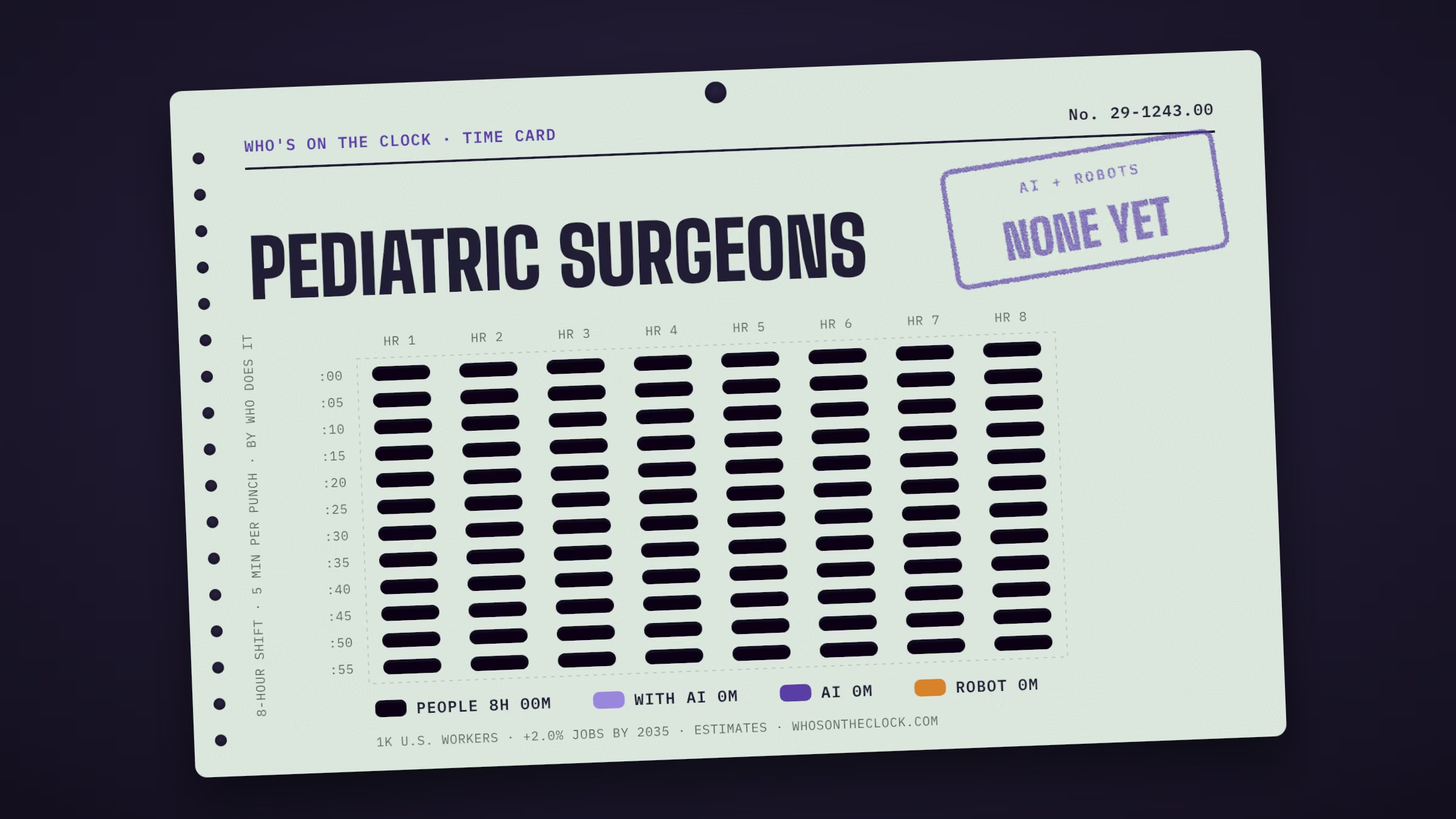
Diagnose and perform surgery to treat fetal abnormalities and birth defects, diseases, and injuries in fetuses, premature and newborn infants, children, and adolescents. Includes all pediatric surgical specialties and subspecialties.
Time card
Untick tasks you don't do, or set your own times.
| Mine | Task, by time spent | Human | With AI | AI | Robot |
|---|---|---|---|---|---|
| Operate on fetuses, infants, children, and adolescents to correct deformities, repair injuries, prevent and treat diseases, or improve or restore patients' functions.2h 21m a shift · No AI or robot evidence found | |||||
| Monitor patient's recovery, making follow-up visits and using postoperative assessment techniques, such as blood and imaging tests.50m a shift · No AI or robot evidence found | |||||
| Examine fetuses, infants, children, and adolescents, and diagnose health issues to determine need for intervention, such as surgery.33m a shift · No AI or robot evidence found | |||||
| Prepare case histories.33m a shift · No AI or robot evidence found | |||||
| Analyze patient's medical history, medication allergies, physical condition, and examination results to verify operation's necessity and to determine best procedure.25m a shift · No AI or robot evidence found | |||||
| Direct and coordinate activities of nurses, assistants, specialists, residents, and other medical staff.25m a shift · No AI or robot evidence found | |||||
| Manage surgery services, including planning, scheduling and coordination, determination of procedures, or procurement of supplies and equipment.25m a shift · No AI or robot evidence found | |||||
| Provide consultation and surgical assistance to other physicians and surgeons.25m a shift · No AI or robot evidence found | |||||
| Conduct research to develop and test surgical techniques that can improve operating procedures and outcomes.21m a shift · No AI or robot evidence found | |||||
| Examine patient to obtain information on medical condition and surgical risk.21m a shift · No AI or robot evidence found | |||||
| Inform parents and guardians of child's health problems and surgical procedures through various channels, such as in-person and telecommunication systems.21m a shift · No AI or robot evidence found | |||||
| Consult with patient's other medical care specialists, such as cardiologist and endocrinologist, to determine if surgery is necessary.17m a shift · No AI or robot evidence found | |||||
| Describe preoperative and postoperative treatments and procedures, such as sedatives, diets, antibiotics, or preparation and treatment of the patient's operative area, to parents or guardians of the patient.17m a shift · No AI or robot evidence found | |||||
| Interpret results of preoperative tests and physical examinations.17m a shift · No AI or robot evidence found | |||||
| Examine instruments, equipment, and operating room to ensure sterility.4m a shift · No AI or robot evidence found | |||||
| Perform transplantation operations, such as organ transplants, on fetuses, infants, children, and adolescents.4m a shift · No AI or robot evidence found | |||||
| Refer patient to medical specialist or other practitioners when necessary.4m a shift · No AI or robot evidence found | |||||
| Follow established surgical techniques during the operation.time not estimated · No AI or robot evidence found |