Will AI replace wood model makers?

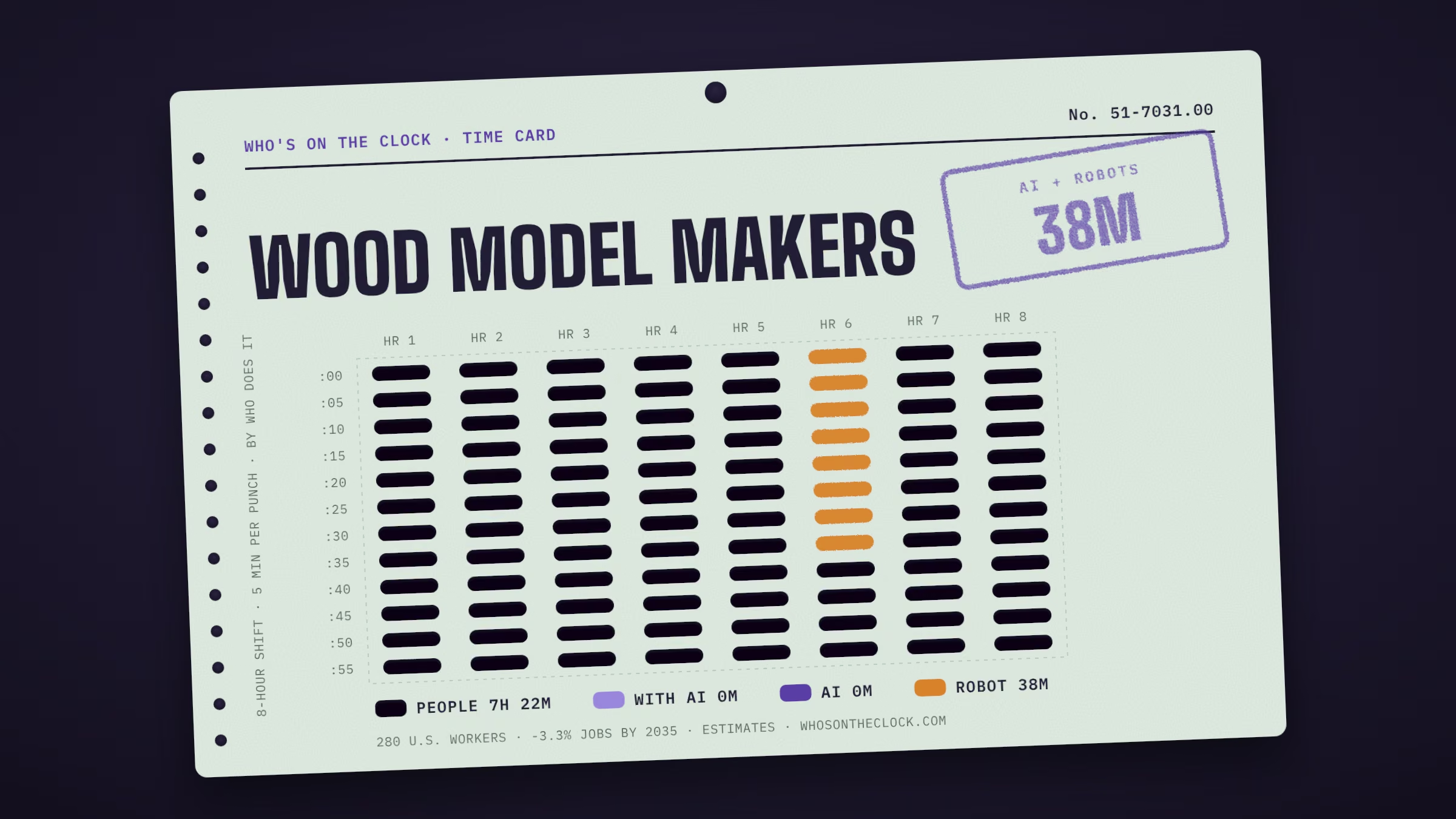
The biggest change here is physical: systems like Nikon APDIS MV4x0 / MV5X Laser Radar have done tasks such as “Verify dimensions and contours of models during hand-forming processes” in real workplaces, about 38m of a typical shift. Most of the rest, 7h 22m, has no AI or robot evidence. BLS expects about 3.3% fewer of these jobs by 2035.

Time card for wood model makers showing a typical 8-hour shift: 7h 22m done by people, 38m by robots.
Each mark is 5 minutes of a typical shift for wood model makers, colored by who does that task today. Estimates from O*NET tasks and Anthropic Economic Index data. How it's made

Home / Production & factory / Wood Model Makers

Construct full-size and scale wooden precision models of products. Includes wood jig builders and loft workers.

Time card

Untick tasks you don't do, or set your own times.
MineTask, by time spentHumanWith AIAIRobot
Fit, fasten, and assemble wood parts together to form patterns, models, or sections, using glue, nails, dowels, bolts, screws, and other fasteners.1h 9m a shift · Robots only in factory cells
Why this label?Robots have done this only in factory setups built around the machine, so it stays Human for wood model makers. How labels work
Trim, smooth, and shape surfaces, and plane, shave, file, scrape, and sand models to attain specified shapes, using hand tools.1h 9m a shift · Robots only in factory cells
Why this label?Robots have done this only in factory setups built around the machine, so it stays Human for wood model makers. How labels work
Set up, operate, and adjust a variety of woodworking machines such as bandsaws and planers to cut and shape sections, parts, and patterns, according to specifications.1h 3m a shift · Robots only in factory cells
Why this label?Robots have done this only in factory setups built around the machine, so it stays Human for wood model makers. How labels work
Construct wooden models, patterns, templates, full scale mock-ups, and molds for parts of products and production tools.57m a shift · Robots only in factory cells
Why this label?Robots have done this only in factory setups built around the machine, so it stays Human for wood model makers. How labels work
Read blueprints, drawings, or written specifications, and consult with designers to determine sizes and shapes of patterns and required machine setups.38m a shift · No AI or robot evidence found
Why this label?No AI use or robot deployment showed up for this task in our data. That isn't proof it's safe; it may just be rare in the data. How labels work
Verify dimensions and contours of models during hand-forming processes, using templates and measuring devices.38m a shift · Robots deployed · e.g. Nikon APDIS MV4x0 / MV5X Laser Radar
Why this label?Marked Robot because Nikon APDIS MV4x0 / MV5X Laser Radar (in real use) has done this task in a real workplace. It shows a robot can do it somewhere, not that most wood model makers work alongside one. How labels work
Select wooden stock, determine layouts, and mark layouts of parts on stock, using precision equipment such as scribers, squares, and protractors.38m a shift · Robots only in factory cells
Why this label?Robots have done this only in factory setups built around the machine, so it stays Human for wood model makers. How labels work
Plan, lay out, and draw outlines of units, sectional patterns, or full-scale mock-ups of products.32m a shift · Robots only in factory cells
Why this label?Robots have done this only in factory setups built around the machine, so it stays Human for wood model makers. How labels work
Finish patterns or models with protective or decorative coatings such as shellac, lacquer, or wax.25m a shift · Robots only in factory cells
Why this label?Robots have done this only in factory setups built around the machine, so it stays Human for wood model makers. How labels work
Mark identifying information on patterns, parts, and templates to indicate assembly methods and details.13m a shift · Robots only in factory cells
Why this label?Robots have done this only in factory setups built around the machine, so it stays Human for wood model makers. How labels work
Maintain pattern records for reference.13m a shift · No AI or robot evidence found
Why this label?No AI use or robot deployment showed up for this task in our data. That isn't proof it's safe; it may just be rare in the data. How labels work
Fabricate work aids such as scrapers or templates.13m a shift · Robots only in factory cells
Why this label?Robots have done this only in factory setups built around the machine, so it stays Human for wood model makers. How labels work
Build jigs that can be used as guides for assembling oversized or special types of box shooks.6m a shift · Robots only in factory cells
Why this label?Robots have done this only in factory setups built around the machine, so it stays Human for wood model makers. How labels work
Issue patterns to designated machine operators.6m a shift · Robots only in factory cells
Why this label?Robots have done this only in factory setups built around the machine, so it stays Human for wood model makers. How labels work

Clock history

  1. 38m touchedFirst published: O*NET 30.1, Anthropic Economic Index (2025 usage and September 2026 robot study), BLS May 2025

When new data changes this clock, the date, the new numbers and the reason are logged here. Company news alone never moves the clock.

On the floor

No company news tracked for this job yet. New stories are added as they happen.

Ask the clock

Will AI replace wood model makers?

Unlikely, though parts of the work are changing. About 38m of an 8-hour shift goes to tasks touched by robots. The other 7h 22m (92%) stays with people. Separately, BLS expects about 3.3% fewer of these jobs by 2035 (all jobs: +3.5%).

What can AI already do for wood model makers?

None of this job's tasks show regular AI use yet. That can mean the work is hands-on or in person, or simply that it rarely comes up in AI usage data.

Where do robots fit in?

For some tasks, yes. Robots have done 1 of this job's tasks in workplaces like this one, about 38m of a typical shift. 11 more tasks have only been done in factory setups built around the machine, so they stay with people here.

  • Verify dimensions and contours of models during hand-forming processes, using templates and measuring devices. (38m a shift; e.g. Nikon APDIS MV4x0 / MV5X Laser Radar, in use)
What still needs a person?

7h 22m of a typical shift, or 92%, goes to tasks with no AI or robot evidence yet. No AI usage or robot deployment has shown up for these so far. The biggest:

  • Fit, fasten, and assemble wood parts together to form patterns, models, or sections, using glue, nails, dowels, bolts, screws, and other fasteners. (1h 9m a shift)
  • Trim, smooth, and shape surfaces, and plane, shave, file, scrape, and sand models to attain specified shapes, using hand tools. (1h 9m a shift)
  • Set up, operate, and adjust a variety of woodworking machines such as bandsaws and planers to cut and shape sections, parts, and patterns, according to specifications. (1h 3m a shift)
  • Construct wooden models, patterns, templates, full scale mock-ups, and molds for parts of products and production tools. (57m a shift)
  • Read blueprints, drawings, or written specifications, and consult with designers to determine sizes and shapes of patterns and required machine setups. (38m a shift)
Why is that work hard to automate?

Much of it comes down to where and how the work happens. In-person, hands-on and high-stakes work is where AI and robots have made the least headway so far. In the official O*NET survey of people in this job:

  • 72% talk face to face with others every day
Are employers still hiring wood model makers?

On Indeed, job postings in the Production & Manufacturing sector are at 124% of their February 2020 level (all U.S. postings: 104%), up 12.6% from a year earlier, as of Oct 9, 2026. BLS separately expects about 100 openings a year in this job through 2035. Across all U.S. postings, 7.3% now mention AI skills. Sector postings cover more than this one job and move for many reasons besides AI.

How much do wood model makers make?

The median pay is about $56,550 a year ($27.19 an hour), 11% above the median for all U.S. jobs ($50,980). Most people in this job earn between $34,800 and $98,050 a year; that range covers the middle 80%. Pay figures are from BLS, May 2025, and vary a lot by state and employer.

Is this job growing or shrinking?

BLS projects a decline of 3.3% from 2025 to 2035, compared with 3.5% growth for all jobs. That's about 700 jobs in 2035. Even so, it expects about 100 openings a year, mostly from people retiring or changing careers. These projections don't single out AI as a cause.

How many wood model makers are there in the U.S.?

About 280 people in the U.S., roughly 0.00% of all workers (BLS, May 2025). That makes it the 794th largest of the 796 jobs on this site. BLS expects about 700 in 2035.

What training do wood model makers need?

The most common requirement is a post-secondary certificate: about 31% of people in the job said so in the official O*NET survey. O*NET rates the job at level 3 of 5 for preparation, which usually means: vocational school or associate's degree. Requirements vary by state and employer, especially for licensed work.

What should I learn to stay ahead of AI?

These come from the job's official skill ratings and from the tasks that AI and robots touch least today. Building them keeps you strong in the parts of the work that still need a person:

  • Skills that matter more here than in most jobs: Operations Monitoring, Time Management, Monitoring, Judgment and Decision Making
  • Get strong at the parts of the job that stay with people (listed above), which take 7h 22m of a typical shift
  • Tools employers list: Microsoft Excel, Microsoft Outlook, Microsoft PowerPoint, Microsoft Word
What other jobs could wood model makers move into?

These use similar skills, with less of a typical shift touched by AI or robots. Matches come from 109 official ratings of skills, knowledge and work activities, and each needs the same or less preparation unless the official list relates the jobs directly:

  • Structural Metal Fabricators and Fitters (0m touched, $51k median pay)
  • Layout Workers, Metal and Plastic (0m touched, $64k median pay)
  • Wood Patternmakers (6m touched, $50k median pay)
  • Model Makers, Metal and Plastic (0m touched, $63k median pay)
  • Cabinetmakers and Bench Carpenters (0m touched, $47k median pay)
How solid are these numbers?

Each task carries its own evidence label. For this job: 1 with robots in real deployments, 13 with no AI or robot evidence found. The minutes per task are estimates, not measured hours, and "no evidence" doesn't prove a task is safe.

Tools in demand

Mostly everyday office tools: Microsoft Excel, Microsoft Outlook, Microsoft PowerPoint, Microsoft Word. The job's skills matter more than any specific software.

Also called

Aircraft Model Maker, Architectural Wood Model Maker, Builder, Building Craftsman, Craftsman, Jig Builder, Jig Maker, Last Model Maker, Loft Worker, Lofter, Model Builder, Model Maker, Product Craftsman, Product Development Carpenter