Will AI replace cardiologists?

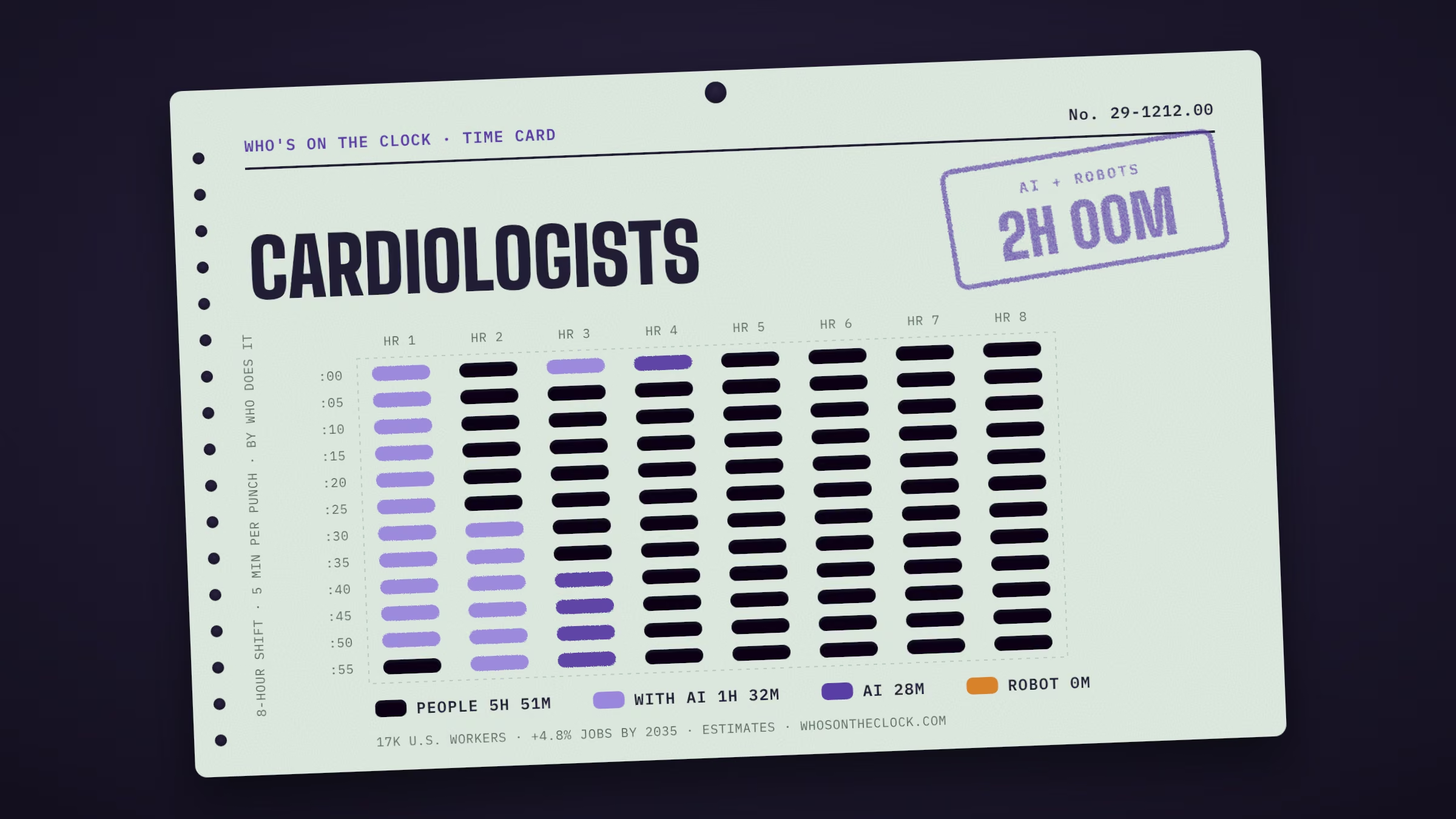
Unlikely, though parts of the work are changing. About 2h of an 8-hour shift goes to tasks touched by AI that people use as a helper. The breakdown: 1h 32m done by people with AI help, 28m that AI mostly does alone. The other 5h 51m (73%) stays with people. Separately, BLS expects about 4.8% more of these jobs by 2035 (all jobs: +3.5%).

Time card for cardiologists showing a typical 8-hour shift: 5h 51m done by people, 1h 32m done by people with AI, 28m by AI.
Each mark is 5 minutes of a typical shift for cardiologists, colored by who does that task today. Estimates from O*NET tasks and Anthropic Economic Index data. How it's made

Home / Healthcare practitioners / Cardiologists

Diagnose, treat, manage, and prevent diseases or conditions of the cardiovascular system. May further subspecialize in interventional procedures (e.g., balloon angioplasty and stent placement), echocardiography, or electrophysiology.

Time card

Untick tasks you don't do, or set your own times.
MineTask, by time spentHumanWith AIAIRobot
Obtain and record patient information, including patient identification, medical history, and examination results.55m a shift · Observed in AI use
Design and explain treatment plans, based on patient information such as medical history, reports, and examination results.37m a shift · No AI or robot evidence found
Diagnose medical conditions of patients, using records, reports, test results, or examination information.37m a shift · Observed in AI useTypical AI request: about 2h 10m alone, 34m with AI
Monitor patients' conditions and progress, and reevaluate treatments, as necessary.37m a shift · No AI or robot evidence found
Explain procedures and discuss test results or prescribed treatments with patients.28m a shift · Observed in AI useTypical AI request: about 1h 30m alone, 30m with AI
Talk to other physicians about patients to create a treatment plan.28m a shift · No AI or robot evidence found
Answer questions that patients have about their health and well-being.23m a shift · No AI or robot evidence found
Conduct electrocardiogram (EKG), phonocardiogram, echocardiogram, or other cardiovascular tests to record patients' cardiac activity, using specialized electronic test equipment, recording devices, or laboratory instruments.23m a shift · No AI or robot evidence found
Diagnose cardiovascular conditions, using cardiac catheterization.23m a shift · No AI or robot evidence found
Advise patients and community members concerning diet, activity, hygiene, or disease prevention.18m a shift · No AI or robot evidence found
Compare measurements of heart wall thickness and chamber sizes to standards to identify abnormalities, using the results of an echocardiogram.18m a shift · No AI or robot evidence found
Order medical tests, such as echocardiograms, electrocardiograms, and angiograms.18m a shift · No AI or robot evidence found
Perform vascular procedures, such as balloon angioplasty and stents.18m a shift · No AI or robot evidence found
Prescribe heart medication to treat or prevent heart problems.18m a shift · No AI or robot evidence found
Administer emergency cardiac care for life-threatening heart problems, such as cardiac arrest and heart attack.14m a shift · No AI or robot evidence found
Supervise or train cardiology technologists or students.14m a shift · No AI or robot evidence found
Conduct exercise electrocardiogram tests to monitor cardiovascular activity under stress.9m a shift · No AI or robot evidence found
Conduct research to develop or test medications, treatments, or procedures that prevent or control disease or injury.9m a shift · No AI or robot evidence found
Observe ultrasound display screen, and listen to signals to record vascular information, such as blood pressure, limb volume changes, oxygen saturation, and cerebral circulation.9m a shift · Robots only in factory cells
Operate diagnostic imaging equipment to produce contrast-enhanced radiographs of heart and cardiovascular system.9m a shift · No AI or robot evidence found
Perform minimally invasive surgical procedures, such as implanting pacemakers and defibrillators.9m a shift · No AI or robot evidence found
Calculate valve areas from blood flow velocity measurements.5m a shift · No AI or robot evidence found
Inject contrast media into patients' blood vessels.5m a shift · Robots only in factory cells
Recommend surgeons or surgical procedures.5m a shift · No AI or robot evidence found
Conduct tests of the pulmonary system, using a spirometer or other respiratory testing equipment.time not estimated · No AI or robot evidence found

On the floor

No company news tracked for this job yet. New stories are added as they happen.

Ask the clock

Will AI replace cardiologists?

Unlikely, though parts of the work are changing. About 2h of an 8-hour shift goes to tasks touched by AI that people use as a helper. The breakdown: 1h 32m done by people with AI help, 28m that AI mostly does alone. The other 5h 51m (73%) stays with people. Separately, BLS expects about 4.8% more of these jobs by 2035 (all jobs: +3.5%).

What can AI already do for cardiologists?

AI shows up regularly in 3 of 25 tasks, about 2h of a typical shift. The biggest ones:

  • Explain procedures and discuss test results or prescribed treatments with patients. (28m a shift, AI mostly does it alone)
  • Obtain and record patient information, including patient identification, medical history, and examination results. (55m a shift, people use AI to help)
  • Diagnose medical conditions of patients, using records, reports, test results, or examination information. (37m a shift, people use AI to help)
Where do robots fit in?

Not in workplaces like this one, based on a 2026 review of robot deployments. 2 more tasks have only been done in factory setups built around the machine, so they stay with people here. For 7 physical tasks, no robot has shown it can do the work yet.

What still needs a person?

5h 51m of a typical shift, or 73%, goes to tasks with no AI or robot evidence yet. No AI usage or robot deployment has shown up for these so far. The biggest:

  • Design and explain treatment plans, based on patient information such as medical history, reports, and examination results. (37m a shift)
  • Monitor patients' conditions and progress, and reevaluate treatments, as necessary. (37m a shift)
  • Talk to other physicians about patients to create a treatment plan. (28m a shift)
  • Answer questions that patients have about their health and well-being. (23m a shift)
  • Conduct electrocardiogram (EKG), phonocardiogram, echocardiogram, or other cardiovascular tests to record patients' cardiac activity, using specialized electronic test equipment, recording devices, or laboratory instruments. (23m a shift)
How much time does AI save on these tasks?

For the 2 tasks in this job where AI shows up and timing data exists, a typical request takes about 1h 50m for a person alone and about 32m with AI. These are Claude's own estimates from real conversations in April and May 2026 (Anthropic Economic Index). They describe single requests, not whole workdays, and time saved on a task doesn't mean jobs are cut. The biggest gaps:

  • Diagnose medical conditions of patients, using records, reports, test results, or examination information (about 2h 10m alone, 34m with AI)
  • Explain procedures and discuss test results or prescribed treatments with patients (about 1h 30m alone, 30m with AI)
Are employers still hiring cardiologists?

On Indeed, job postings in the Physicians & Surgeons sector are at 202% of their February 2020 level (all U.S. postings: 104%), up 8.8% from a year earlier, as of Oct 9, 2026. BLS separately expects about 500 openings a year in this job through 2035. Across all U.S. postings, 7.3% now mention AI skills. Sector postings cover more than this one job and move for many reasons besides AI.

How much do cardiologists make?

The median pay is about $496,010 a year ($238.47 an hour), 873% above the median for all U.S. jobs ($50,980). Most people in this job earn between $107,190 and $712,130 or more a year; that range covers the middle 80%. Pay figures are from BLS, May 2025, and vary a lot by state and employer. Pick a state to compare:

Is this job growing or shrinking?

BLS projects growth of 4.8% from 2025 to 2035, compared with 3.5% growth for all jobs. That's about 19,000 jobs in 2035. It expects about 500 openings a year, mostly from people retiring or changing careers. These projections don't single out AI as a cause.

How many cardiologists are there in the U.S.?

About 17,000 people in the U.S., roughly 0.01% of all workers (BLS, May 2025). That makes it the 574th largest of the 796 jobs on this site. BLS expects about 19,000 in 2035.

What training do cardiologists need?

O*NET rates the job at level 5 of 5 for preparation, which usually means: graduate degree. Requirements vary by state and employer, especially for licensed work.

What should I learn to stay ahead of AI?

These come from the job's official skill ratings and from the tasks that AI and robots touch least today. Building them keeps you strong in the parts of the work that still need a person:

  • Get strong at the parts of the job that stay with people (listed above), which take 5h 51m of a typical shift
  • Tools employers list: Epic Systems, MEDITECH software
  • Learn to use AI well on the tasks where it already shows up in this job (listed above)
What other jobs could cardiologists move into?

These use similar skills. Matches come from 109 official ratings of skills, knowledge and work activities, and each needs the same or less preparation unless the official list relates the jobs directly:

  • Pediatric Surgeons (0m touched, $559k median pay)
  • General Internal Medicine Physicians (2h 7m touched, $257k median pay)
  • Anesthesiologists (57m touched, $391k median pay)
  • Urologists (1h 17m touched, $266k median pay)
  • Emergency Medicine Physicians (46m touched, $336k median pay)
How solid are these numbers?

Each task carries its own evidence label. For this job: 3 observed in real AI use, 22 with no AI or robot evidence found. The minutes per task are estimates, not measured hours, and "no evidence" doesn't prove a task is safe.

Tools in demand

  • Epic Systems
  • MEDITECH software

Also called

Cardiac Specialist, Cardiologist, Cardiology Non-Invasive Physician, Cardiology Physician, Electrophysiology Cardiologist, General Cardiologist, Heart Failure Cardiologist, Interventional Cardiologist, Interventional Cardiology Physician, Invasive Cardiologist, Medical Doctor (MD), Non-Invasive Cardiologist, Noninvasive Cardiologist, Pediatric Cardiologist