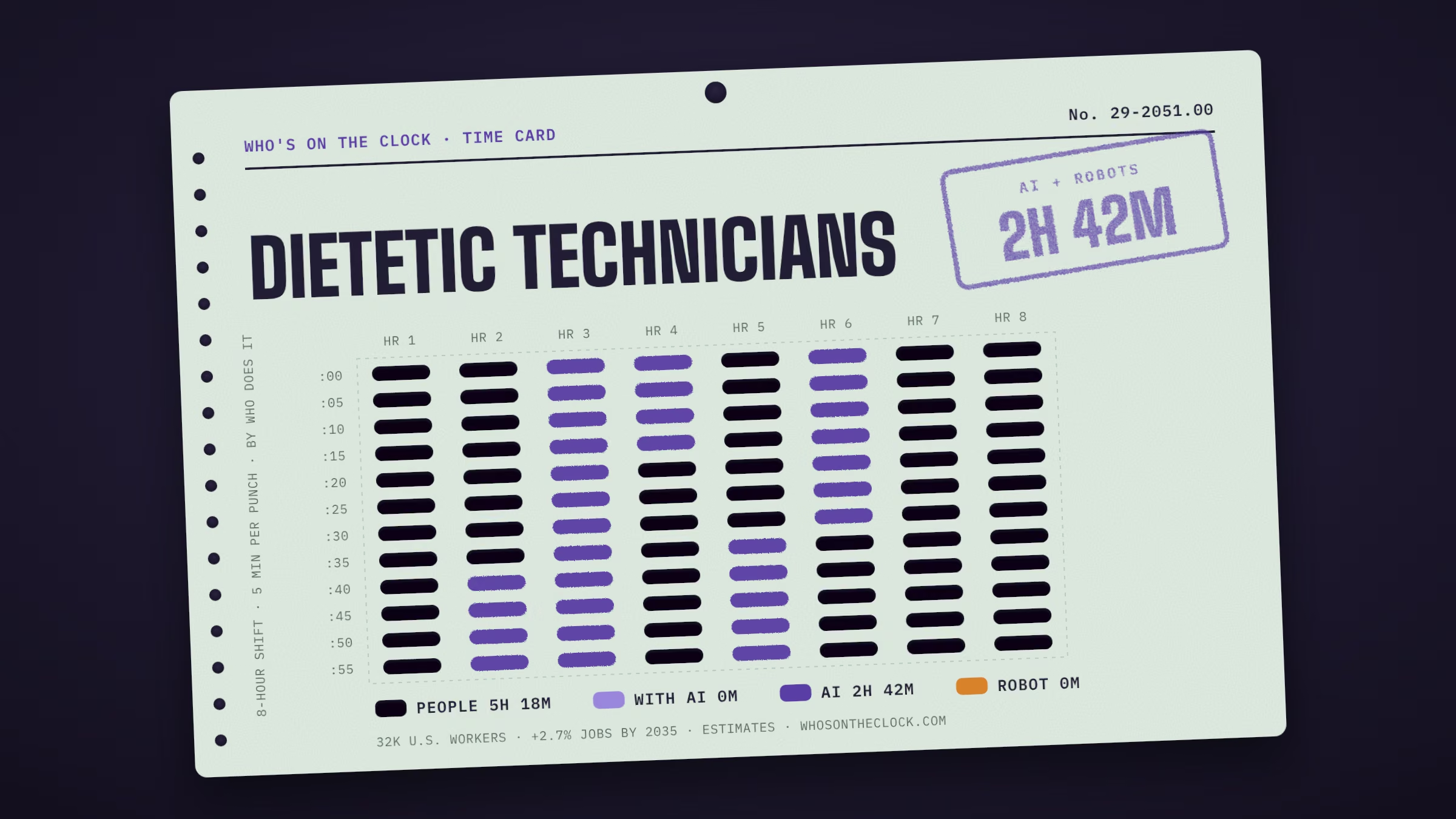
Some tasks are already handled by AI or machines; the rest still needs a person. About 2h 42m of an 8-hour shift goes to tasks that AI or robots largely take over. The other 5h 18m (66%) stays with people. Separately, BLS expects about 2.7% more of these jobs by 2035 (all jobs: +3.5%).
⤢ Full sizeEach mark is 5 minutes of a typical shift for dietetic technicians, colored by who does that task today. Estimates from O*NET tasks and Anthropic Economic Index data. How it's made
Assist in the provision of food service and nutritional programs, under the supervision of a dietitian. May plan and produce meals based on established guidelines, teach principles of food and nutrition, or counsel individuals.
Time card
Untick tasks you don't do, or set your own times.
Mine
Task, by time spent
Human
With AI
AI
Robot
Observe and monitor patient food intake and body weight, and report changes, progress, and dietary problems to dietician.1h 40m a shift · No AI or robot evidence found
Conduct nutritional assessments of individuals, including obtaining and evaluating individuals' dietary histories, to plan nutritional programs.1h 40m a shift · Observed in AI useTypical AI request: about 6h 20m alone, 1h 49m with AI
Supervise food production or service or assist dietitians or nutritionists in food service supervision or planning.1h 15m a shift · No AI or robot evidence found
Plan menus or diets or guide individuals or families in food selection, preparation, or menu planning, based upon nutritional needs and established guidelines.1h 2m a shift · Observed in AI use
Prepare a major meal, following recipes and determining group food quantities.31m a shift · Robots only in factory cells
Attend interdisciplinary meetings with other health care professionals to discuss patient care.25m a shift · No AI or robot evidence found
Provide dietitians with assistance researching food, nutrition, or food service systems.19m a shift · No AI or robot evidence found
Analyze menus or recipes, standardize recipes, or test new products.19m a shift · No AI or robot evidence found
Develop job specifications, job descriptions, or work schedules.12m a shift · No AI or robot evidence found
Select, schedule, or conduct orientation or in-service education programs.12m a shift · No AI or robot evidence found
Determine food and beverage costs and assist in implementing cost control procedures.12m a shift · No AI or robot evidence found
Refer patients to other relevant services to provide continuity of care.6m a shift · No AI or robot evidence found
Deliver speeches on diet, nutrition, or health to promote healthy eating habits and illness prevention and treatment.6m a shift · No AI or robot evidence found
On the floor
No company news tracked for this job yet. New stories are added as they happen.
Ask the clock
Will AI replace dietetic technicians?
Some tasks are already handled by AI or machines; the rest still needs a person. About 2h 42m of an 8-hour shift goes to tasks that AI or robots largely take over. The other 5h 18m (66%) stays with people. Separately, BLS expects about 2.7% more of these jobs by 2035 (all jobs: +3.5%).
What can AI already do for dietetic technicians?
AI shows up regularly in 2 of 13 tasks, about 2h 42m of a typical shift. The biggest ones:
Conduct nutritional assessments of individuals, including obtaining and evaluating individuals' dietary histories, to plan nutritional programs. (1h 40m a shift, AI mostly does it alone)
Plan menus or diets or guide individuals or families in food selection, preparation, or menu planning, based upon nutritional needs and established guidelines. (1h 2m a shift, AI mostly does it alone)
Where do robots fit in?
Not in workplaces like this one, based on a 2026 review of robot deployments. 1 more task has only been done in factory setups built around the machine, so it stays with people here. For 2 physical tasks, no robot has shown it can do the work yet.
What still needs a person?
5h 18m of a typical shift, or 66%, goes to tasks with no AI or robot evidence yet. No AI usage or robot deployment has shown up for these so far. The biggest:
Observe and monitor patient food intake and body weight, and report changes, progress, and dietary problems to dietician. (1h 40m a shift)
Supervise food production or service or assist dietitians or nutritionists in food service supervision or planning. (1h 15m a shift)
Prepare a major meal, following recipes and determining group food quantities. (31m a shift)
Attend interdisciplinary meetings with other health care professionals to discuss patient care. (25m a shift)
Provide dietitians with assistance researching food, nutrition, or food service systems. (19m a shift)
Why is that work hard to automate?
Much of it comes down to where and how the work happens. In-person, hands-on and high-stakes work is where AI and robots have made the least headway so far. In the official O*NET survey of people in this job:
91% carry high or very high responsibility for other workers' safety
82% are exposed to disease or infection every day
75% say dealing with the public is very or extremely important
How much time does AI save on these tasks?
For the 1 task in this job where AI shows up and timing data exists, a typical request takes about 6h 20m for a person alone and about 1h 49m with AI. These are Claude's own estimates from real conversations in April and May 2026 (Anthropic Economic Index). They describe single requests, not whole workdays, and time saved on a task doesn't mean jobs are cut. The biggest gaps:
Conduct nutritional assessments of individuals, including obtaining and evaluating individuals' dietary histories, to plan nutritional programs (about 6h 20m alone, 1h 49m with AI)
Are employers still hiring dietetic technicians?
On Indeed, job postings in the Medical Technician sector are at 125% of their February 2020 level (all U.S. postings: 104%), down 2.6% from a year earlier, as of Oct 9, 2026. BLS separately expects about 4,200 openings a year in this job through 2035. Across all U.S. postings, 7.3% now mention AI skills. Sector postings cover more than this one job and move for many reasons besides AI.
How much do dietetic technicians make?
The median pay is about $37,640 a year ($18.09 an hour), 26% below the median for all U.S. jobs ($50,980). Most people in this job earn between $29,720 and $54,020 a year; that range covers the middle 80%. Pay figures are from BLS, May 2025, and vary a lot by state and employer. Pick a state to compare:
Is this job growing or shrinking?
BLS projects growth of 2.7% from 2025 to 2035, compared with 3.5% growth for all jobs. That's about 33,000 jobs in 2035. It expects about 4,200 openings a year, mostly from people retiring or changing careers. These projections don't single out AI as a cause.
How many dietetic technicians are there in the U.S.?
About 32,000 people in the U.S., roughly 0.02% of all workers (BLS, May 2025). That makes it the 469th largest of the 796 jobs on this site. BLS expects about 33,000 in 2035.
What training do dietetic technicians need?
The most common requirement is an associate's degree: about 35% of people in the job said so in the official O*NET survey. O*NET rates the job at level 3 of 5 for preparation, which usually means: vocational school or associate's degree. Requirements vary by state and employer, especially for licensed work.
What should I learn to stay ahead of AI?
These come from the job's official skill ratings and from the tasks that AI and robots touch least today. Building them keeps you strong in the parts of the work that still need a person:
Skills that matter more here than in most jobs: Learning Strategies, Instructing, Service Orientation, Active Learning
Get strong at the parts of the job that stay with people (listed above), which take 5h 18m of a typical shift
Tools employers list: Microsoft Office software, MEDITECH software, Microsoft Access, Microsoft Excel, Microsoft Outlook
Learn to use AI well on the tasks where it already shows up in this job (listed above)
What other jobs could dietetic technicians move into?
These use similar skills. Matches come from 109 official ratings of skills, knowledge and work activities, and each needs the same or less preparation unless the official list relates the jobs directly:
Dietitians and Nutritionists (1h 8m touched, $76k median pay)
Health Education Specialists (1h 11m touched, $64k median pay)
Home Health Aides (14m touched, $36k median pay)
Psychiatric Technicians (0m touched, $45k median pay)
Community Health Workers (47m touched, $52k median pay)
How solid are these numbers?
Each task carries its own evidence label. For this job: 2 observed in real AI use, 11 with no AI or robot evidence found. The minutes per task are estimates, not measured hours, and "no evidence" doesn't prove a task is safe.